The turbocharger on a car applies a very similar principle to a piston engine. It uses the exhaust gas to drive a turbine. This spins an air compressor that pushes extra air (and oxygen) into the cylinders, allowing them to burn more fuel each second.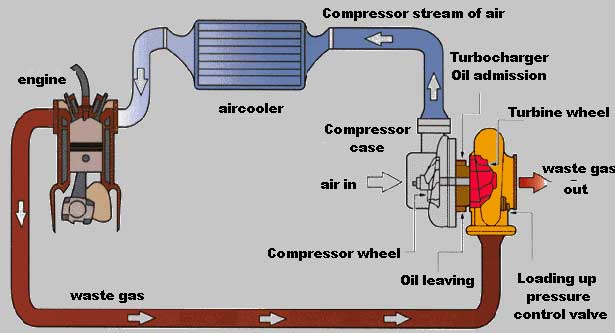
An engine is designed to burn a fuel-air mixture to produce mechanical energy. The mechanical energy then moves pistons up and down to create the rotary motion that turns the wheels of a vehicle. The more mechanical energy, the more power the engine can produce.
A significant difference between a turbocharged diesel engine and a traditional naturally aspirated gasoline engine is that the air entering a diesel engine is compressed before the fuel is injected. This is where the turbocharger is critical to the power output and efficiency of the diesel engine. It is the job of the turbocharger to compress more air flowing into the engine’s cylinder. When air is compressed the oxygen molecules are packed closer together. This increase in air means that more fuel can be added for the same size naturally aspirated engine. This generates increased mechanical power and overall efficiency improvement of the combustion process. Therefore, the engine size can be reduced for a turbocharged engine leading to better packaging, weight saving benefits and overall improved fuel economy.


No comments:
Post a Comment