Total Pageviews

Friday, 24 June 2016

TFSI-TURBO FUEL STRATIFIED INJECTION ENGINE

THE TURBO FUEL STRATIFIED INJECTION- denotes a type of forced-aspiration(turbo) engine where fuel is force injected into the combustion chamber so as to create a stratified charge.It increases the power and torque of spark ignition engines,makes them economical and reduces the emission to a great extent.
Now what is a stratified charge engine ?-It is a type of internal combustion engine where there fuel is directly fed into the cylinder before ignition.This allows for higher compression ratios and a leaner air-fuel ratio than that of the conventional internal-combustion engines.
                     Conventionally the internal combustion engines used the Otto-Cycle or the constant volume cycle methodology during the intake stroke.This produces a homogeneous charge which is ignited at the predetermined moment at the beginning of the compression stroke.In the homogeneous charge system the air-fuel ratio is kept very close to stoichiometric,which in other words mean that the air content in the air-fuel mixture is just sufficient for complete combustion.But,the major drawback of this system is that it puts an upper-limit to the engine efficiency,results in unstable combustion which notably impacts the power and emission(especially for that of the nitrogen oxides).
(AUDI'S NEW A3 THE FACELIFTED VERSION IS GOING TO GET A 2.0L TFSI PETROL ENGINE)

Sunday, 1 May 2016

PROBLEMS FOR A TURBO CHARGED ENGINE(THE TURBO LAG)

THE TURBO LAG:

The turbo lag is a sluggish response from an automotive motor ,wherein below a certain RPM one experiences a delay- from the time the car is throttled and the time the engine responds to the accelerator input.It's a serious issue for an motor and engineers all over the world are trying to eradicate it.
                   
 This actually affects the city drivability the most as one needs to frequently work the gears in order to maintain a certain RPM level in a car.So, as the engine RPM rises the turbocharger also starts to spin faster and only after it has attained a certain RPM
you start to feel that sudden rush of torque.Therefore in a car engine where there's an issue of turbo lag the throttle responses won't follow a linear curve because the power surges up only after a certain RPM level is maintained.
(THIS IS  A SERIOUS  ASPECT   THAT   THE  CAR  BUYERS  SHOULD  KEEP INTO  MIND  BECAUSE  IT  IS   A TREMENDOUS  DRAWBACK  FOR  A  VEHICLE  AND  CAN  BE  SERIOUSLY  ANNOYING  AT  TIMES.)
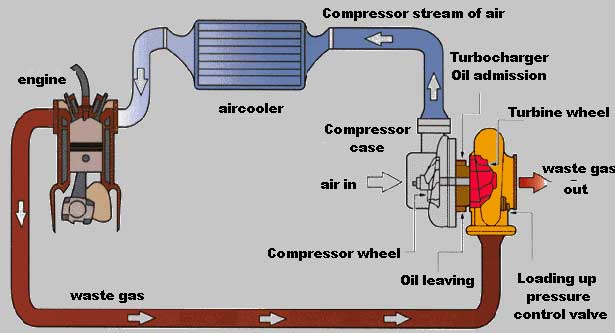
Earlier in my article on TURBO CHARGED ENGINES I had already highlighted the working of a turbo charged engine.So, in order to brief-up how a turbo works by using the exhaust air to spin a turbine which is mounted on the same shaft as that of a compressor.The compressed air is then fed into the engine.This helps to maximize the power output for a given engine size.The turbine pumps in more air and hence more fuel into the combustion chamber than that of the normal atmospheric pressure.Therefore the turbo chargers depends on the pressure of the exhaust gases and needs a short time to build up this pressure(specially when then motor is revving at low rpms).So one needs to work the gears quite frequently in order to supply the engine with required RPM input.
This issue though not fully nullified but has been curbed to a great extent with the concept of VARIABLE GEOMETRY TURBO which would be discussed later.

Thursday, 28 April 2016

TURBO CHARGED ENGINE(PRINCIPLE OF TURBO CHARGERS)


The turbocharger on a car applies a very similar principle to a piston engine. It uses the exhaust gas to drive a turbine. This spins an air compressor that pushes extra air (and oxygen) into the cylinders, allowing them to burn more fuel each second.
An engine is designed to burn a fuel-air mixture to produce mechanical energy. The mechanical energy then moves pistons up and down to create the rotary motion that turns the wheels of a vehicle. The more mechanical energy, the more power the engine can produce.
A significant difference between a turbocharged diesel engine and a traditional naturally aspirated gasoline engine is that the air entering a diesel engine is compressed before the fuel is injected. This is where the turbocharger is critical to the power output and efficiency of the diesel engine. It is the job of the turbocharger to compress more air flowing into the engine’s cylinder. When air is compressed the oxygen molecules are packed closer together. This increase in air means that more fuel can be added for the same size naturally aspirated engine. This generates increased mechanical power and overall efficiency improvement of the combustion process. Therefore, the engine size can be reduced for a turbocharged engine leading to better packaging, weight saving benefits and overall improved fuel economy.